
Steve Mann, Durham masons’ guild member and local cathedral stone mason has created works of art from stone, and he continues to develop his skills during his employment at Durham cathedral. His work is testimony to the age-old craft and art of shaping stone for quality construction and decorative purposes. Steve is an artisan and his stone carvings attract much public interest.
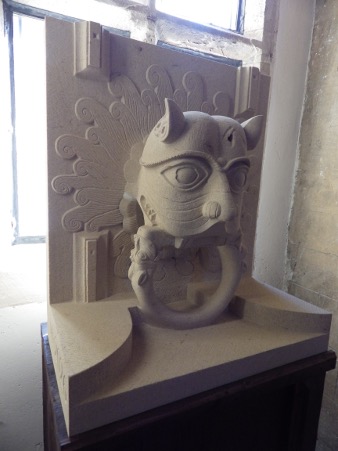
Figure 1 – Sanctuary Ring in sand stone
Steve’s latest completed project as displayed in Figure 1 was a long-term challenge comprising 450 hours work, undertaken in the undercroft at Durham cathedral in his own time. It was a challenge of huge difficulty and is a stone copy of the world famous Sanctuary ring carved from a 314kg block of Blaxter sandstone. Dunhouse quarry near Staindrop were the suppliers of the stone. This quarry is used extensively for renovation work at Durham Cathedral as the sandstone bed darkens when it extends further inland, thus matching the weathered stone more effectively when renovations are carried out. Steve’s Sanctuary Ring is on display (Figure 2 – 2026) in the Cathedral museum which was once the Monks dormitory.
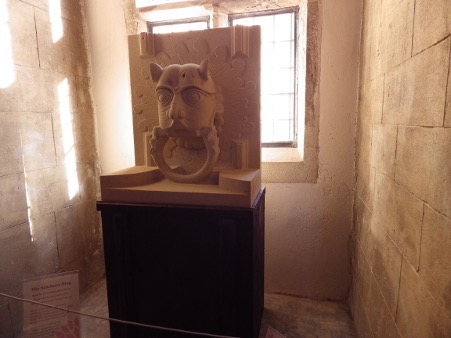
Figure 2 – Sanctuary Ring in situ – Cathedral Museum
A bronze copy of the original ring is positioned on the North entrance door of Durham cathedral. The Sanctuary ring has symbolism within its construction and is based upon the Medieval Hellmouth image, designed to frighten away evil. The detail in Figure 3, shows a man’s legs hanging out of a lion’s mouth whilst his feet are bitten by a double headed snake.
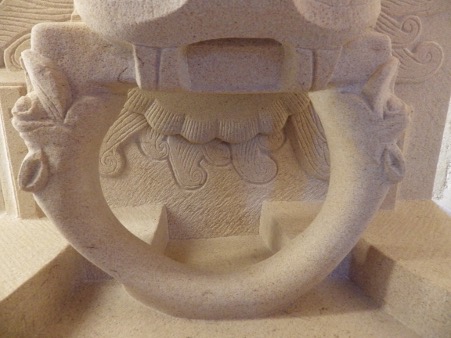
Figure 3 – Hellmouth detail.
A practical use attributed to the ring was that of providing sanctuary for those fleeing justice. The fugitive had 37 days to decide whether to face justice by trial or leave the country. This practice was abolished in 1624.
Previous works carried out by Steve at Durham cathedral are many as he plies his craft as part of the masons’ team at Durham cathedral. A well-received sandstone Royal Cipher of King Charles III is a fairly recent addition of Steves portfolio of work.
Steve was given the honour of adding to the long list of Bishops and Deans of Durham cathedral and monastery on a plaque near the tomb of St Cuthbert. The new Dean of Durham Cathedral, Philip Plyming was added to the list of Deans and Bishops who oversaw the operation of the original monastery, starting with Bishop Hugh de Puiset 1153. Following the Reformation the monastery became the Cathedral we know today.
Steve was honoured to be asked to carve the inscription, and he executed it to the best his ability with great care and attention. It is a testimony to Steve’s skill, and he left his mason’s mark in the best way possible. His works are currently on display to the public visiting the cathedral.
Durham City Freeman Mason Steve Mann has left a legacy for the cathedral beyond his role as cathedral stone mason and most importantly is carrying on the centuries old tradition of stone carving as practised by Freemen through time.